What lives in the trunk from November to March
Winter tournament driving is its own sport. The kit, the rules and the one decision that matters more than any of them.
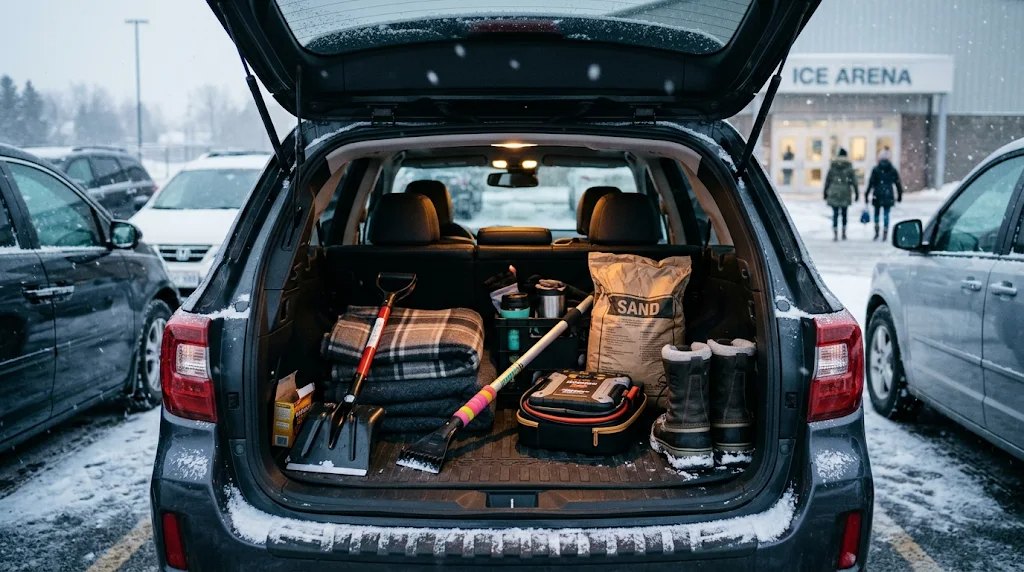
In most of the country, club season means winter driving. Six a.m. departures on roads that have not been plowed. Two-hour drives that become four. A parking lot at a rink in a town with one gas station and a forecast that changed while you were inside. Sports parents log more winter highway miles than almost anyone who does not drive for a living, and most of us do it with a scraper and optimism.
This is the kit that lives in the trunk from the first tournament in November until the last one in March, and the few rules that go with it.
The kit
- A real scraper with a brush. Not the free one. A long-handled one that can clear a minivan roof, because snow that flies off your roof onto someone's windshield at seventy miles an hour is a crime in some states and a near-death experience in all of them.
- A small shovel. Collapsible is fine. You will use it in a hotel lot at 6 a.m. at least once a season.
- Traction. A bag of sand or cat litter, or a set of traction mats. The rink parking lot is sheet ice by Sunday morning and nobody is coming to push you.
- Jumper cables or a battery jump pack. Cold kills batteries, and the team parent with the jump pack is a hero twice a winter.
- Blankets. Two. Wool or fleece. For the kid who falls asleep on the way home, and for the hour on the shoulder if things go badly.
- Boots, hats and gloves for everyone, separate from the ones people are wearing. The pair you are wearing will be wet.
- Water and food that does not freeze solid. Nuts, bars, crackers. Not the good stuff from the cooler. Emergency stuff.
- A phone charger that works on a car port and a battery pack that lives in the glove box.
- A flashlight or headlamp. The one on your phone is not a flashlight; it is a reason your phone is dead.
- Washer fluid rated for cold, and a spare jug. Road salt will empty a reservoir in forty miles.
- Hand warmers. For the car, for the rink, for the long walk from the back lot.
- A paper copy of the hotel address and the venue address. When the phone dies on a rural highway, the paper is the map.
Habits that help
- Leave earlier than you think, then leave fifteen minutes before that. The teams that make the 7:30 warm-up on a snow morning left at 4:45.
- Full tank at departure, every time. Half a tank on a closed highway is a long cold afternoon.
- Check the road, not the weather. State transportation sites show plowing, closures and camera feeds. The forecast tells you it is snowing. The road site tells you whether you can get there.
- Follow the plow, do not pass it. Everything in front of it is worse than everything behind it.
- Drive the conditions, not the GPS arrival time. The app does not know about black ice.
The one decision that matters
Some mornings the answer is not to go. A tournament is not worth the drive when the highway is closed, the forecast is a blizzard and the hotel is two hours away in a town you have never seen. Coaches know this. Clubs know this. Your kid will be disappointed, and your kid will also be alive. Make the call the night before when you can, and make it as a family so nobody is standing in the driveway at 5 a.m. arguing with a snowbank.
Carpooling in winter
Winter is the strongest case for sharing the drive. One experienced winter driver in a vehicle with good tires is safer than two nervous ones in two sedans, and if something does go wrong, two adults in one car is a very different situation than one adult in each. When you check in at a winter tournament in the app, the Carpools room exists for exactly this. Post the route and the time, and take the parent from your town with you.
In March
Leave the kit in. Minnesota and Michigan and Colorado have all seen a foot of snow in April, and the last tournament of the season is the one where everyone has already put the shovel away. Clean out the trunk the week after the banquet. Not before.
Friends, Dating, or both. Adults only.