The convention center parking playbook
The tournament starts at 8. The parking fight starts at 7:15. Here is how to never lose it again.
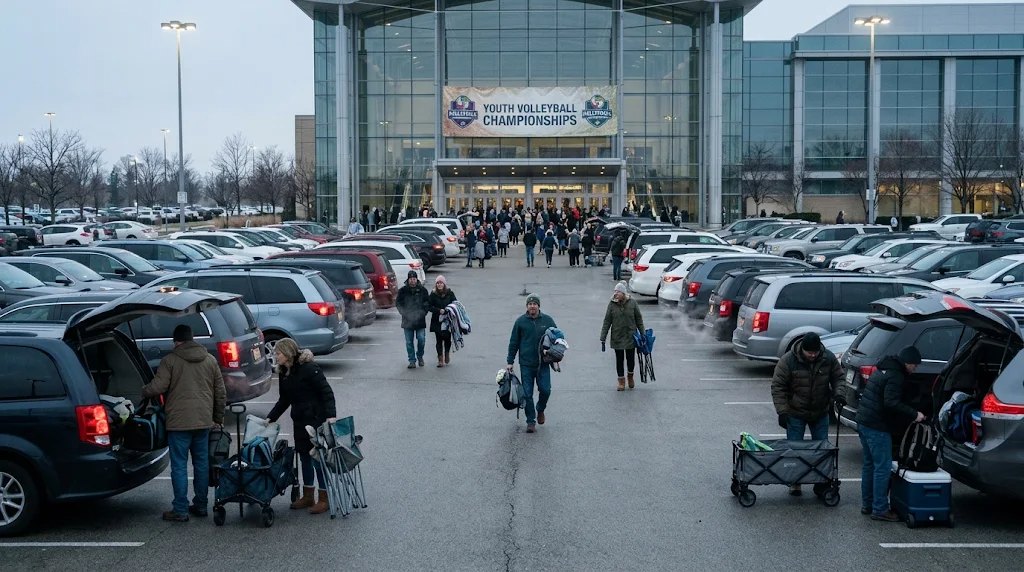
Nobody puts it on the schedule, but the first event of every big tournament weekend is parking, and it is a contact sport. Four hundred families, one convention center, three surface lots, a ramp with a broken gate arm and a street that will be towed at 10 a.m. sharp. The parents who have done this before are already inside with a coffee while the rest of the circuit is circling the block.
Here is how they do it.
The night before
- Look at the venue on a map, in satellite view. Find the main entrance, then find the lot that is behind the venue, not in front of it. Front lots fill first and cost most. Back lots and the lot of the office building next door are where the veterans go.
- Check the tournament's own parking note. Many big events publish a parking map, a discount code for a nearby ramp, or a warning about which streets are permit-only. It is usually buried in the same email as the wristband rules.
- Look at the hotel. If you are staying within half a mile, you may be better off leaving the car at the hotel and walking. Hotel parking is already paid for and nobody tows you.
Arrival
- Arrive forty-five minutes before warm-ups, not fifteen. The difference between those two times is the difference between the back lot and the street six blocks away.
- Drop the player and the gear at the door first, then park. One parent walks the kid in; the other parks and carries the chairs. If you are solo, drop the gear bag with another parent you trust, then park. Do not try to carry a volleyball bag, two chairs and a cooler four blocks.
- Back in. You will be leaving in a hurry, in the dark, in a lot full of people who are also leaving in a hurry. Backing in at 7 a.m. is free. Backing out at 7 p.m. is a twenty-minute negotiation.
The ramp question
Ramps are more expensive and slower to exit, but they are covered, they are rarely towed and the car is cool in summer and clear of snow in winter. If you are there all day, the ramp is usually worth it. If you are there for a single match, the street is fine as long as you read every sign. Twice.
Read the signs like they are trying to trick you
Because they are. Street parking near big venues is the city's favorite revenue source on tournament weekends. Look for: hours that change on Saturday, permit zones that start mid-block, snow emergency routes, and the sign a block up that applies to the whole street. If a space is suspiciously open on a full street, there is a reason.
Cash and apps
Many surface lots on tournament days are run by a person with a lawn chair and a cash box. Have twenty dollars in small bills. Many city ramps and meters now run on an app, so download the one for the city before you leave home and set it up while you still have signal.
Leaving
- Know your exit before you need it. Note which gate you came in and whether it is the same gate everyone else will use.
- If your kid's last match ends with everyone else's, wait fifteen minutes. Let the kid cool down, get the cooler packed, and leave after the first wave. You will be home at the same time with half the stress.
- Pay before you walk back to the car if the ramp has a pay station. The line at the exit gate is the line you want to skip.
The move nobody tells you
Introduce yourself to the lot attendant on Saturday morning. Ask how the day usually goes, where people get towed, whether the lot fills by noon. Attendants know the venue better than anyone with a lanyard and they will remember the one parent who treated them like a person. On Sunday, when the lot is full, that is the parent who gets waved in.
Carpool, obviously
Every car you take off the road is one less car in the lot, one less fee and one less person circling. If two families are driving from the same town to the same tournament, the parking playbook is simple: one car.
Parking is not the point of the weekend. But a bad parking morning sets the tone for ten hours in a gym, and a good one buys you a calm cup of coffee and a seat with a back. Plan it like the veterans do.
Friends, Dating, or both. Adults only.